It is always good to feel in control of your actions. This has never been more true than when driving a vehicle. A driver must feel in control of the vehicle’s manoeuvrability. The tyres of the vehicle, which is the point of contact with the road, play an important role in giving the driver confidence.
Why your car’s wheels are not aligned
It has always been the case that car care is all about spending a little money and time every now and again to avoid a huge bill down the road. It is important to keep your tyres well maintained. We will now explain three of the most important aspects of tyre maintenance: wheel alignment, wheel balance and tyre rotating.
Wheel Alignment
What is wheel alignment ?
Many people mistakenly believe that the alignment process is an adjustment of the wheels themselves. Wheel Alignment in Calgary is the process of adjusting the suspension to get the right angle for the tyres to make contact with the road.
Alignment problems
- A sudden impact on the highway
- High speed pothole collision
- Minor collisions, or if you hit a curb
- Sudden manoeuvres
What are the signs that your alignment is out of whack?
- It may be that your car feels unnaturally heavy to one side and you find it difficult to maintain a straight line, even at low speeds. Your car is unintentionally running to one side.
- When the steering wheel starts to vibrate heavily
- Indented tread wear is visible on the tyres
How can misalignment be corrected?
The misalignment occurs when the tyres are not positioned in the same linear position. To correct this, the technician will focus on three factors:
- Caster angle is the difference in angular distance between the vertical axis on the wheel being steered and the steering axis. It is important to maintain stability and balance when steering the vehicle. To correct misalignment, the mechanic will find a fine balance between positive and negative caster angles.
- Camber angle is the difference between the vertical axis (wheels) and the vertical axis (car), when viewed in front.
- Toe angle is the angle that the tyres form when moving inwards or outwards along the longitudinal axis, viewed at a top-angle.
The wheel alignment will be achieved once all three angles are in line.
Wheel Balancing
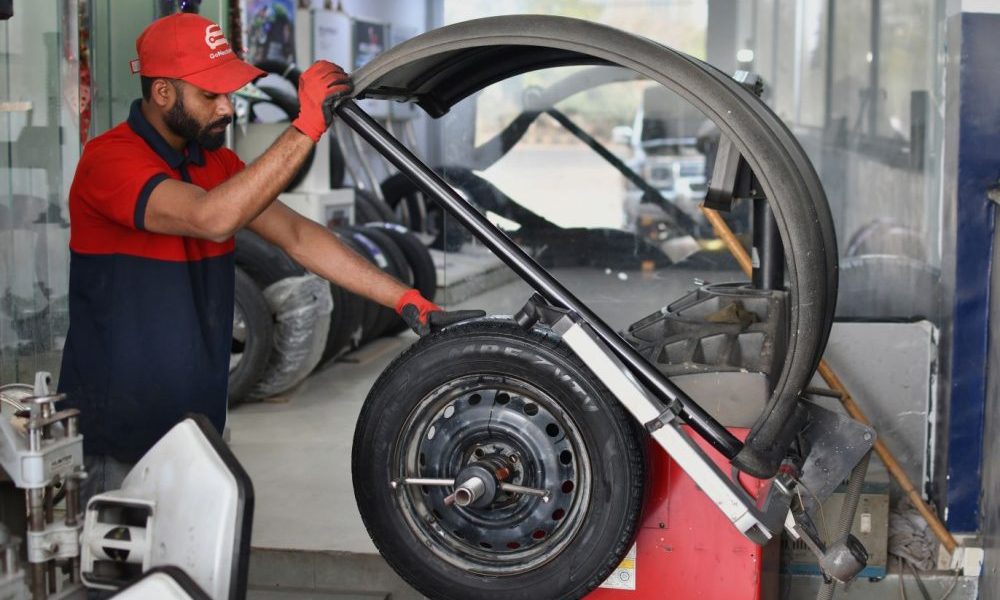
Wheel balancing is a process that is concerned only with the wheel-tyre relationship. It is the process of correcting an imbalance between the weights of a wheel and a tyre. The wheel alignment is done in conjunction with the balancing to maintain coordination between weight and alignment.
It is important to maintain a balance in the weight of your wheel/tyre combo for a stable and smooth drive. This will also reduce tyre wear, and eliminate vibrations. Unbalanced tires increase the risk of suspension and wheel damage.
How to balance a wheel?
- Step 1. Remove all four tyres from the vehicle. Place them on a computerised wheel balancing machine.
- Step 2. The computer simulates the weight distribution of all four wheels.
- Step 3. Counterweights are placed on the rim exactly where the computer tells you to.
- Step 4. If the wheel imbalance persists, it is checked again.
If you need to use counterweights that are more than 100 grams for a single rim, you may want to change your rim or tire.
How often should you have your wheels aligned and balanced?
The wheel alignment and balancing process should be performed after a 6000-8000km average, and when you buy a new set tyres.
Rotation of the Tyre
This is also something you should do while your vehicle is being aligned and balanced.
The wear of the tyres is not uniform across all four wheels, whether you have a front-wheel-drive, rear-wheel-drive, four-wheel-drive or all-wheel-drive car. The two front tyres are always subjected more to pressure because of constant steering, braking, and the fact that the majority of weight is shifted to the front.
To ensure that all four tyres wear uniformly, it’s best to swap tyres on the spare, front and rear wheels.
The four-wheel method and five-wheel method are both used to rotate a tyre. There are different patterns for front-wheel, rear-wheel, and all-wheel drive cars.
Four Wheel Rotation
- Front-wheel Drive
Install the front wheels on the rear hubs that correspond to them. The rear wheels are then crisscrossed on both sides with the front hubs, i.e. the front-left wheel is placed onto the rear-left side, and the back-left wheel on the forward-right side. - All-Wheel Drive and Rear-Wheel Drive
Install the rear wheels on the front hubs that correspond to them. The rear wheels are then crisscrossed by the front hubs, i.e. the left rear wheel is installed on the left front side, and the right front wheel on the right rear side.
Five Wheel Rotation
- Front-wheel Drive
The rear left wheel is then used as the spare wheel, while the spare wheel is installed in place of front right. The spare wheel will be installed on the right-hand side of the wheel. The front left wheel is then replaced by the rear right wheel, and the rotation is complete. - All-Wheel Drive and Rear-Wheel Drive
The front wheels will be crisscrossed, and then installed on opposite rear wheel hubs. The spare wheel is then installed on the right front wheel hub, while the rear left wheel is installed on front left hub. The spare wheel is replaced by the rear right wheel.
Rotating the tyres is essential for better performance and a longer life span.
Wheel Alignment and Wheel Balancing are vital services that need professional assistance. At alignment king you will find expert mechanics and technicians, high-quality workshops and equipment and 100% original OEM and OES parts for your car.
You can also save up to 40% on services by comparing to authorized service centres. What are you waiting for? Experience quality car services and solutions at alignment king.